
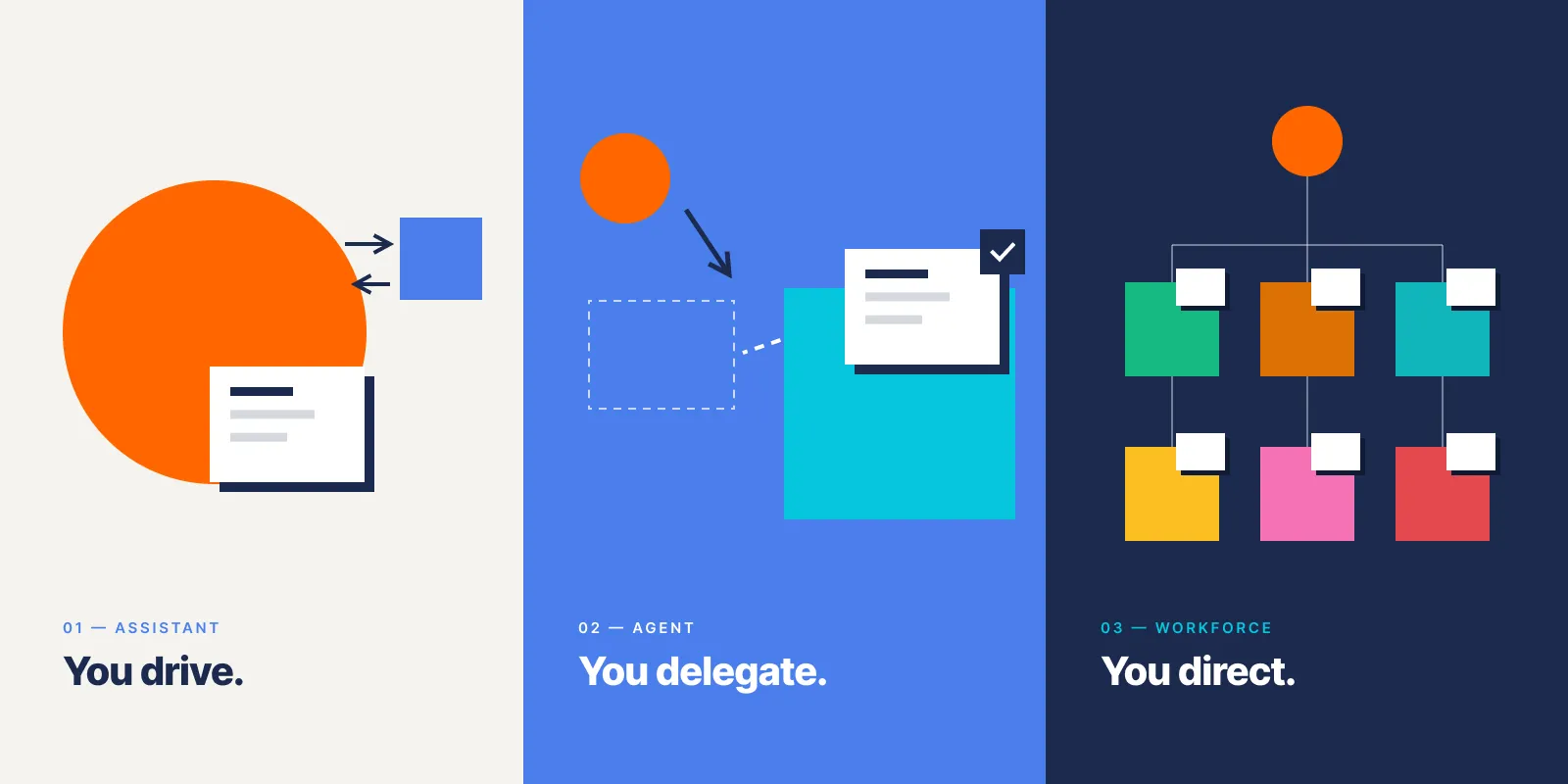
AI terminology is multiplying faster than the products themselves. Assistant, copilot, agent, autonomous agent, digital worker, AI workforce. To make things more confusing, the same product may be described as an “assistant” one day and an “agent” a few months later.
A better way to separate these concepts is not by product labels, but by the responsibility they take on.
At the simplest level:
- An AI Assistant helps you do the work.
- An AI Agent takes on a defined task and works toward an outcome.
- An AI Workforce is a system in which agents with different roles operate as part of a real organization.
This is not a good-better-best hierarchy. Each model is right for different kinds of work. The important question is not how much AI you use. It is how much responsibility you are willing to give it.
AI Assistant: You’re still in the driver’s seat
When you work with an AI assistant, you still own the process.
You ask it to draft an email. Summarize a report. Review a piece of code. Suggest alternative headlines for a presentation. You evaluate the output and decide what happens next.
That way of working is extremely useful. For many tasks, you do not need anything more.
If you are thinking through an idea, improving a piece of writing, or exploring options before making a decision, the assistant model works well because you want the human to stay actively involved and steer each step.
The basic interaction looks like this:
- You ask.
- AI responds.
- You evaluate.
- You initiate the next step.
AI Agent: You assign a task, not a question
With an agent, the relationship starts to change.
You do not simply ask, “How could I solve this problem?” You give the problem to the agent.
Take a software team.
“What might be causing this bug?” is an assistant question.
“Review this ticket, find the issue, fix it, run the tests, and open a pull request” is a task you can delegate to an agent.
In the second case, producing one useful answer is not enough. The AI needs access to the repository. It needs to understand the existing code, follow the project’s rules, complete several steps, and check its own work where necessary.
One of the important distinctions OpenAI has made around agents in 2026 is exactly this shift: the unit of knowledge work is moving away from short AI interactions and toward delegated tasks that can run for longer periods of time.
It may sound like a small change in wording. In practice, it changes how work gets organized.
The objective is no longer simply to get a better answer. It is to build a system that can deliver an outcome.
And autonomy is not the goal by itself. What an agent can access, which actions it can take independently, when it must ask for approval, and how visible its work is are just as important as the intelligence of the underlying model.
AI Workforce: Not one agent, but a way of working
An agent can take ownership of a task. An AI Workforce takes that idea to the organizational level.
In a real company, we do not give every kind of work to one person. A software developer, a customer service specialist, an HR professional, and an operations manager have different roles. They use different systems, have different permissions, carry different responsibilities, and need different context.
The same should be true for digital workers.
A software agent may need access to GitHub and project documentation. A customer support agent may need the CRM, product knowledge, and conversation history. An agent moderating social channels will work with a completely different set of tools and rules.
An AI Workforce does not try to collapse all of these roles into one “super-agent.”
It does the opposite. It separates the work.
- Each agent has a role.
- It gets the tools it needs.
- Its permissions are bounded.
- Its memory is defined.
- Its work is observable.
- And the way it collaborates with people or other agents is designed deliberately.
Seen this way, an AI Workforce is not primarily a model problem. It is an organizational design problem.
When does an agent start behaving like a real worker?
We use the word “worker” deliberately.
Because the expectation from a digital worker is not simply that it produces a good answer.
- It needs to know which project it is working on.
- It needs to understand its role.
- It needs to know the rules the company has set for that work.
- It needs access to the right systems.
- It should remember relevant past decisions.
- It needs to know when to stop and hand the work back to a person.
Most importantly, it needs to treat an assigned task not as a chat session, but as a responsibility that should be carried through.
You do not remind an employee every morning who they are, which team they belong to, and how the company works.
In the long run, we will not want to do that with AI either.
The human role isn’t disappearing. It’s changing.
Conversations about agents quickly turn into a familiar question: “Will AI replace people?”
There is a more interesting shift already happening inside companies.
People are moving away from doing every step themselves and toward defining objectives, delegating work, setting standards, and evaluating outcomes.
Microsoft’s 2026 Work Trend Index describes this shift in terms of execution and agency: as agents take on more execution work, the human role increasingly moves toward direction, judgment, and ownership of results.
A good AI system, then, should not be designed to remove the human from the process.
It should reduce the amount of human time spent in the wrong parts of the process.
Not every task should become an agent task
There is an important boundary here.
Turning every task into an agent workflow is not a good idea.
When the creative direction is still unclear, uncertainty is high, sensitive human relationships are involved, or a decision is difficult to reverse, direct human involvement may be the better choice.
Agents are strongest when the objective can be defined, the necessary context is available, the tools are known, and the outcome can be checked.
So the most useful question is not:
“Can AI do this?”
A better question is:
“Can I define the objective, boundaries, and success criteria clearly enough to delegate this work?”
How we think about this at Rakita
When we build Rakita, our goal is not to create one powerful AI that does everything.
It is to create digital workers that can take on different kinds of work and operate in different roles.
Kurt, for example, is not designed to be a chatbot that answers questions about code. The goal is for Kurt to work more like a developer: take an assigned task, understand the project context, work in the repository, follow the team’s rules, and move the work forward inside the existing development process.
Another agent may be responsible for customer communication. Another for operations, recruitment, or moderation.
Even if they are built on the same family of models, they are not the same worker.
What makes them different is not only their intelligence. It is their role, memory, access, workspace, and responsibility.
In short
If you want to make a task faster, an AI Assistant may be enough.
If you want to delegate a task, you need an AI Agent.
If you want multiple digital workers to operate inside real business processes, you are starting to design an AI Workforce.
We believe this is where the more important transformation will happen over the next few years.
Companies will move from asking, “Which AI tool should we use?” to asking, “How should we divide work between people and agents?”
The second question is much bigger than the first.