
AI is no longer just a tool that answers our questions. It is beginning to take on work, use tools, retain context, and keep going until it reaches a defined outcome. This shift is redrawing the line between “using AI” and “working with AI.”
At Rakita, we call this new way of working an AI Workforce.
AI Assistants, AI Agents, and AI Workforce Are Not the Same Thing
For the past few years, the dominant AI experience has been the assistant: you ask a question, it generates a piece of text, summarizes a file, or gives you an idea. Valuable, yes — but the human still sits at the center of every interaction. You ask, AI responds. When something new comes up, you provide the context again and steer it again.
With an AI agent, that relationship begins to change. An agent does more than generate an answer; it takes a goal, uses the tools available to it, manages intermediate steps, and works toward an outcome.
An AI Workforce is the next layer.
Instead of relying on one powerful agent, it describes an organization in which agents with different roles, permissions, memories, and workspaces operate together. Just like a real team, not everyone needs to do the same job. One agent may handle software development, another customer conversations, and another support recruitment workflows.
The point is not to use more AI. It is to give the right work to the right digital worker.
From Prompts to Tasks
In the generative AI era, the fundamental unit of interaction was the prompt.
- “Write this email.”
- “Fix this code.”
- “Summarize this report.”
With agentic AI, that fundamental unit is increasingly becoming the task.
- “Resolve this ticket.”
- “Handle this customer request.”
- “Screen these candidates.”
- “Review this campaign’s performance and identify the next actions.”
The difference may sound small, but it changes the way work gets done.
When you delegate a task, you do not expect the other side to simply make a suggestion. You expect it to understand the context, take the necessary steps, use tools when needed, and complete the work. That is the starting point of the AI Workforce idea.
The Difference Between a Chatbot and a Digital Worker
A chatbot is usually session-based. When the conversation ends, the work ends with it.
A digital worker requires continuity.
- It should know which project it is working on.
- It should know its role and responsibilities.
- It should know which tools it can access.
- It should know which rules it must follow.
- It should remember previous work and decisions when that context is relevant.
- It should know when to continue independently and when to come back to a human.
That is why building an AI Workforce is not simply about choosing a powerful model. A model provides intelligence; becoming a worker also requires a role, memory, permissions, tools, boundaries, and observability.
Why Now?
The capabilities of agent systems are changing quickly. OpenAI has described knowledge work as shifting from short AI interactions toward longer-running delegated tasks. McKinsey, meanwhile, uses the term “hybrid workforce” for organizations in which people and AI agents work side by side.
The common thread is clear: AI is no longer being treated only as an assistant that helps people do their work faster. It is becoming a new layer of capacity that can take ownership of specific work.
That creates a new set of questions for companies.
- Which work should remain human?
- Which work can be delegated to AI?
- What should an agent remember?
- Which systems should it be able to access?
- How autonomous should it be?
- Who should manage it?
- And when a company has dozens or hundreds of agents, how should they be organized?
The idea of an AI Workforce requires all of these questions to be considered together.
An AI Workforce Is Not Hundreds of Bots Replacing Employees
There is an important distinction here.
The goal of an AI Workforce is not to remove people from the system. It is to expand human capacity and distribute work more intelligently.
Not everyone on a team does the same kind of work. Some work requires creativity, empathy, relationship management, judgment, or accountability. Other work requires large amounts of context scanning, repetition, follow-up, execution, and operational effort.
AI agents can increasingly take responsibility for work in the second category.
As that happens, the human role changes too. Instead of being the person who manually performs every step, the human becomes the one who defines the goal, delegates the work, sets the boundaries, and manages the outcome.
In other words, AI does not remove people from the workflow. It redesigns the relationship between people and work.
How Should an AI Workforce Be Built?
The first instinct is often to build one super-agent that can do everything. There is a reason real organizations do not work that way: roles create clarity.
You would not want a software developer, an HR specialist, and a customer service representative to have the same permissions, the same memory, or the same operating rules. The same principle applies to digital workers.
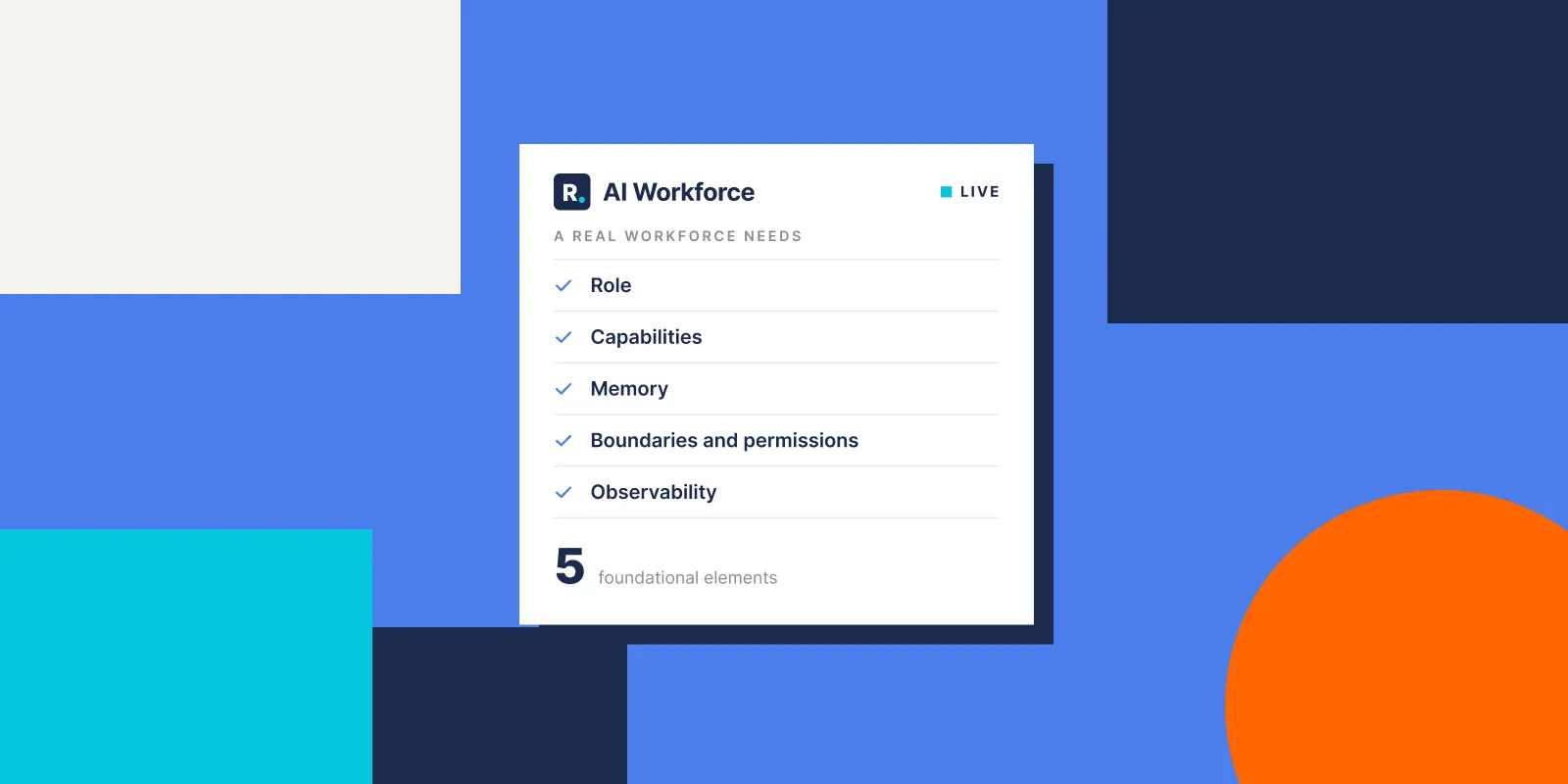
A healthy AI Workforce needs at least five foundational elements:
- Role — Defines why the agent exists and what responsibility it owns.
- Capabilities — Defines which applications, tools, and systems it can use.
- Memory — Allows it to remember projects, decisions, preferences, and previous work when relevant.
- Boundaries and permissions — Defines what it can do independently and when it needs approval.
- Observability — Makes what it did, why it made a decision, and where the work currently stands visible.
Without these elements, you may have powerful AI tools. But you do not yet have a workforce.
Rakita’s Approach
This distinction is exactly where we started when building Rakita.
We do not think of agents simply as AI characters you talk to. We think of them as digital workers with a role, responsibilities, and a workspace inside a team.
Kurt, for example, is not being designed as another coding assistant. It is designed to work like a developer on the team. It should be able to take a task, understand the relevant project and rules, work on the codebase, perform the necessary checks, and move the work forward within the team’s existing workflow.
The same logic applies to other roles.
The goal is not to make one AI do everything.
It is to give the right work to an agent with the right role.
The Future of AI May Not Be a Chat Window
Today, we mostly imagine working with AI through a chat interface. But in the future of work, the primary interface may not be conversation. It may be delegation.
- You assign a task.
- The work moves forward.
- It comes back to you when needed.
- It delivers the result.
Just like a member of the team.
That is why we believe the next transformation will not simply create “better chatbots.” It will create a new layer of workforce capacity.
AI Assistants helped us.
AI Agents started taking on work.
AI Workforce is where those agents become part of a real organization.
And we believe the real shift is only beginning.